Developers
22 articles
 Model routing
Settling one job across many operators
A single agent task can touch several independent operators: a primary that stalls, a hedge that answers, a successor that takes over a session, expert shards held on different machines. How Tenzro routes that work, settles each operator for its own part, and what the buyer, each operator and an auditor can see.
6 min read Payments for machines
Payment rails for machines
Invoices and cards assume a person, a merchant and an amount large enough to carry a fixed cost. Machines buying AI work need per-call settlement, payment channels for high-frequency calls and delegated spending under limits. How those rails work on Tenzro, and how they sit alongside x402 and AP2.
5 min read Payments for machines
Spending limits and revocation for agents
When software spends money, someone has to answer for it. That takes a responsible party behind every agent, limits the agent cannot raise itself, and a revocation that stops payment on every rail at once. How each of those works on Tenzro, and why each has to be enforced outside the agent.
5 min read Consensus
Inside Tenzro's Consensus: DAG-Based BFT for a Network of Machines
How Tenzro orders transactions with a DAG protocol, makes finality portable with hardware-signed checkpoint certificates, hands over between committees at epoch boundaries, and checks the code against a formal model step by step.
6 min read Model routing
Build, rent or network? Sourcing AI inference in 2026
CTOs now have three ways to source AI inference: build on their own hardware, rent from a cloud or model API, or buy from an open network of independent providers. This guide compares them on the criteria that decide the outcome: demand shape, model choice, jurisdiction, verification and exit.
5 min read Edge AI
Agentic Harnesses on Small Devices: Orchestrating From the Edge
Most of an agent's work is orchestration, not large-model inference. Why the harness belongs on small hardware near the data, what runs on a Tenzro edge node today, and what edge harness hosting will add once it ships.
5 min read Consensus
Breaking Our Own Network: Chaos Testing a BFT Consensus
How we partition, restart and skew a private Tenzro network on purpose, what we check while it happens, and the class of catch-up bug that taught us to measure progress by what a node actually executed.
6 min read Computer vision
Computer Vision at the Edge: Infer Locally, Escalate Rarely
Cameras produce far more pixels than anyone should ship to a data centre. A tiered architecture for vision AI: small detectors at the camera or gateway, larger models only for the frames that need them, and privacy built into the split.
4 min read Safety
Designing Safe Harnesses: Scopes, Limits, Expiry and Revocation
Prompt injection will sometimes succeed, so an agent's safety has to live outside the model. How Tenzro bounds every delegated agent with consensus-enforced scopes, spending limits, expiry, step-up approval and revocation, with an accountable root behind each one.
5 min read Generative media
Generative Media Pipelines: Right Hardware, Pay Per Result
Image, video and audio generation have cost profiles unlike chat. How to route each job to hardware that fits it, meter it in units that match the work, check licence territory and mark outputs for provenance.
5 min read Machine economy
Machines That Pay Machines: Accounting for Autonomous AI Work
When agents buy inference, data and compute from other machines, the hard parts are accounting, receipts, limits and settlement, not the payment rail. How Tenzro records each payment once, binds it to what was asked and delivered, and settles in the rails people already use.
5 min read Networking
 for Distributed Inference: Gossip, Re-announcement and Load
A network of machines behind home routers, carrier NAT and corporate proxies still has to deliver every transaction and every heartbeat. How Tenzro's transport, gossip budgets and re-announcement keep messages from getting lost under load.
5 min read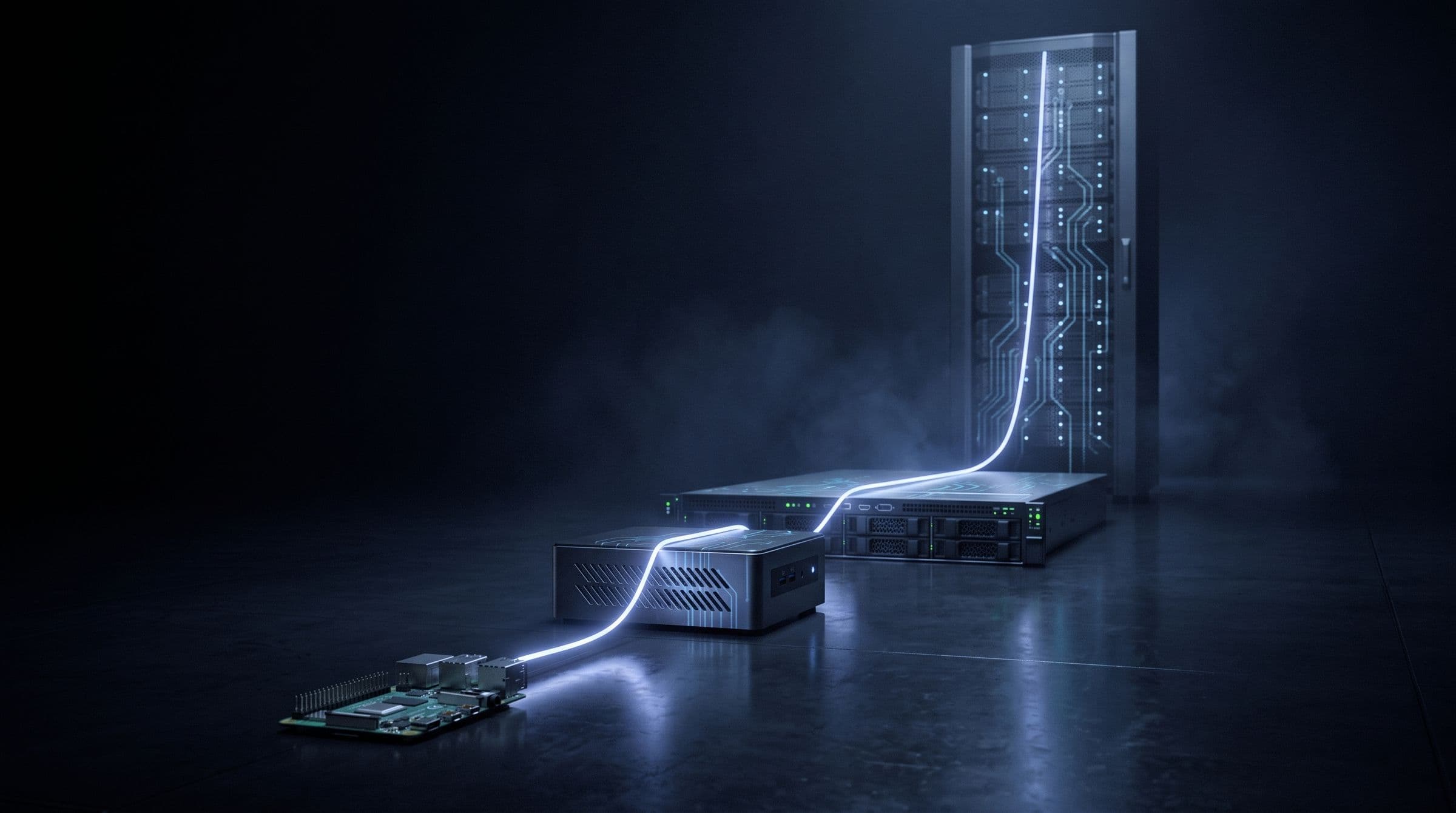 Edge AI
One Codebase From a Single-Board Computer to a Rack
Tenzro builds one node for every class of machine, from a Raspberry Pi to a GPU server, by varying compiled features and resource presets rather than forking the code. How the tiers work, what we measured, and why small devices belong in an AI network.
5 min read Retrieval
 at the Source: Embeddings and Search Near the Data
Retrieval pipelines copy an organisation's documents into embeddings, indexes and caches, often far from where the data lives. Why embeddings are sensitive data, how to size them, and an architecture that keeps retrieval close to the source.
4 min read Model routing
Routing Across Many Providers, and Why Receipts Must Be Verifiable
A model router chooses on price, latency and standing, hedges the slow tail and fails over in seconds. None of that is trustworthy unless each answer comes with a receipt a third party can check. How Tenzro does both.
5 min read Voice AI
 Latency Budgets: Serve Speech Close to the Speaker
People expect a reply within a few hundred milliseconds. A latency budget for voice agents, where each millisecond goes, and why speech recognition and synthesis belong near the user while the language model can sit further away.
4 min read Machine economy
Six upgrades to Tenzro Network
Tenzro Network starts again from a fresh genesis with six upgrades: post-quantum DAG consensus, keys held in hardware, trust and provenance, metered settlement, inference for any model and an RPC that is closed by default.
5 min read Machine economy
Introducing Tenzro Network
Why we are building an open network for the Machine Economy, where humans, agents and machines buy, sell and settle computing work.
2 min read Hardware identity
TDIP: one identity protocol for humans and machines
Humans, delegated agents and autonomous agents under one W3C DID method, with keys rooted in passkeys and device hardware. Why agents need an identity of their own.
2 min read Distributed computing
Multi-VM runtime: EVM and SVM on one ledger
How the Tenzro ledger runs the EVM and the SVM on one state, alongside native transactions, with one native TNZO balance and Block-STM parallel execution.
2 min read Confidential computing
TEE security: verified attestation across vendors
Intel TDX, AMD SEV-SNP, AWS Nitro and NVIDIA confidential GPUs, each attestation verified to its vendor root. Attestation is evidence; keys stay in their owners' hardware.
2 min read Payments for machines
Payments for AI agents: open rails, one network
x402, MPP, AP2, ACP and stablecoin wallets: why agents should not have to know which rail their counterparty accepts, and how Tenzro settles them all.
2 min read